Chemtrails? Those trails are ice.
Here's the proof.
I fly for a living. Let me show you what condensation trails really are, why they only appear in a narrow band of altitudes — and why fighter pilots have spent 80 years trying to avoid making the very trails the chemtrail theory says are sprayed on purpose.
Are chemtrails real?
No. The white trails behind high-flying aircraft are contrails — condensation trails of ice crystals that form when hot, moist jet exhaust meets air colder than about −40 °C. Whether a trail vanishes in seconds or spreads across the whole sky depends on the humidity at cruise altitude, not on any chemical additive. Peer-reviewed research, four US federal science agencies and 76 of the 77 leading atmospheric scientists surveyed agree.
The long answer — the physics, the military history, and every classic photo explained — starts below.
A letter from the flight deck
Dear readers,
As a pilot, I occasionally come across fascinating stories about my profession. A while back there was a conspiracy theory about extraterrestrial life hiding in certain lens-shaped clouds (lenticular and banner clouds). Fortunately I haven't heard much about it lately — probably for the best, as I often fly through such clouds. :)
There is, however, another theory that is far more persistent — pun intended: the idea that the white trails which linger and spread behind aircraft are "chemtrails", chemicals sprayed to influence the climate or the population. Below I'll share the facts, and as you might guess, I don't entirely agree. :)

On a deeper level, even a page of counterarguments is somewhat futile — who is trying to convince whom? Conspiracy theories can be entertaining, but when they start inducing fear it's time to return to the facts and ask the magic question: who conducted the research? That means avoiding vague claims like "everyone knows it," or photos that turn out to be something else entirely (you'll see plenty below), or "researchers have proven that…" — which researchers? Was the research properly done? On this page, every major claim links to its source: peer-reviewed papers, military weather manuals, and official fact sheets. Check them yourself — that's the whole point.
A bit about me: I'm a captain and Line Trainer on a Cessna Citation Latitude business jet — flying a small jet means I sometimes literally check my own fuel with my own hands, as I used to do on the Hawker 800 at London City (you'll find those photos further down). I'm also deeply involved in meditation and spiritual practice together with my wife. So I'm not someone who can be described as purely grounded or practical — I simply want the facts to be facts.
I hope that with the science below you can let go of the fear. The sky is doing exactly what physics says it must.

The white lines are contrails — condensation trails — artificial clouds of ice crystals. Jet engines burn kerosene, and burning 1 kg of kerosene produces about 1.23 kg of water vapour (more than the fuel's own weight, because the fuel's hydrogen combines with oxygen from the air). At cruise altitude, around 10 km up, the outside air is brutally cold — typically −54 °C at 35,000 ft. Cold air can hold almost no water vapour, so the extra moisture condenses into droplets that freeze into ice within about one wingspan behind the aircraft. It's the same physics as seeing your breath on a frosty morning, just at forty below.
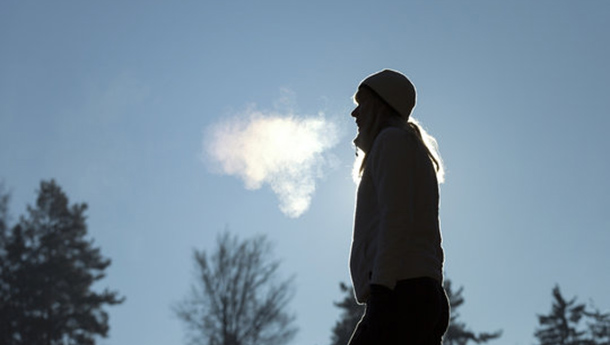
Why some trails vanish and some stay all day
Here is the single most misunderstood fact in this whole debate: the ambient air decides how long a trail lives, not the aircraft. If the air at cruise level is dry, the ice crystals sublimate away in seconds to minutes. But if the air is ice-supersaturated — holding more moisture than ice can be in equilibrium with — the crystals keep growing by feeding on the atmosphere's own water, and the trail persists for hours, spreading into sheets of cirrus.
"Jet engine exhaust provides only a small portion of the water that forms ice in persistent contrails. Persistent contrails are mainly composed of water naturally present along the aircraft flight path." — Joint EPA / FAA / NASA / NOAA Aircraft Contrails Factsheet (EPA430-F-00-005)
Airliner-mounted instruments (the European MOZAIC programme) measured ice-supersaturated air on about 13.5% of cruise flight time. So roughly one flight-hour in seven crosses air where trails persist — and six in seven where they can't. That is why the same aircraft, on the same route, leaves nothing on Monday and paints the sky on Tuesday. No switch in the cockpit; just weather. Old-school pilots and meteorologists even used it as a forecast: trails that linger and spread mean humid air aloft — often a sign of an approaching weather change within a day or two.
And what's actually in the exhaust besides water? The same things every engine emits: CO₂ and small amounts of soot, unburnt hydrocarbons and nitrogen oxides — regulated, measured, and published. The four-agency fact sheet above states contrails are ice, pose no health risk, and that the crystals evaporate long before they could ever reach the ground. See the full breakdown of what a contrail consists of here — including the famous "lab tests" of collected rainwater, explained line by line.
Part 2 — The centrepiece
The altitude band: why trails switch on and off
This is the piece of physics that, once you see it, makes the whole conspiracy collapse. Contrails are not possible everywhere — they exist only inside a band of altitudes, and the band's boundaries are set by thermodynamics that were worked out before the jet age even began.
In 1941 the German thermodynamicist Ernst Schmidt published the theory; in 1953 U.S. Air Force meteorologist Herbert Appleman independently derived it again and turned it into an operational forecasting chart. To this day it's called the Schmidt–Appleman criterion. The engine exhaust adds water and heat to the air in a fixed ratio. A trail can only form if, while the hot moist exhaust mixes with the freezing ambient air, the mixture momentarily reaches saturation. That happens only when the outside air is colder than a threshold — roughly −40 °C (humidity shifts it a few degrees either way).
Below the band: too warm
Climbing out of an airport in the temperate latitudes where most of us live, you won't see an airliner making a contrail at 10,000 ft. The air is simply too warm — the exhaust plume mixes away without ever reaching saturation. In the standard atmosphere the air crosses −40 °C only around 26,000–28,000 ft — right where NASA's GLOBE programme puts the bottom of the band, at about 8–12 km (26,000–39,000 ft). (Polar winter air is the exception that proves the temperature rule: at −40 °C near the ground in places like Alaska or Siberia, even low-flying aircraft can leave trails of ice fog.)
Above the band: trails switch off again
Here's the beautiful part — the part hardly anyone knows. Going higher does not keep making trails easier. Two things happen at once. First, at lower pressure the criterion demands an even colder temperature. Second, above the tropopause (about 36,000 ft in the standard atmosphere) the atmosphere stops getting colder — in the stratosphere temperature holds steady and eventually rises. The threshold keeps running away downward while the real temperature refuses to follow, and stratospheric air is bone-dry on top of it. Result: the band closes from above. Research radiosonde data over Paris shows conditions for persistent trails sit consistently 1–1.6 km below the tropopause — the dry lowermost stratosphere offers very little potential for persistent contrails. (Short-lived trails can still form in very cold stratospheric air — which is exactly why U-2 and B-2 crews keep checking — but the persistent, sky-filling kind lives below the tropopause.) This is why the IPCC noted that raising cruise levels would sharply reduce persistent contrails at mid-latitudes, with some compensating increase in the tropics, where the tropopause sits far higher.
Why you see more trails than your grandparents did
Two documented reasons — no chemicals required. First, traffic: over 100,000 flights per day now cross the sky. Second, engines: modern high-bypass turbofans are far more efficient, which means less heat goes out the exhaust with the same water. A cooler-but-equally-moist plume saturates more easily, so efficient engines make trails at warmer temperatures. The IPCC quantified it: raising engine efficiency from 0.3 to 0.5 extends contrail formation roughly 700 m (2,300 ft) lower. In 1999, DLR proved it in flight (published in 2000): two aircraft flew side by side, and only the one with the more efficient engines left a trail. Same sky, same moment, one trail — pure thermodynamics.
In short: trails appear exactly where an 85-year-old formula says they must, switch off above and below exactly where it says they must, and appear more often today for exactly the reasons it predicts. A secret programme has no room left to hide in this physics.
If you believe trails are sprayed on purpose, here is the strongest counter-evidence in existence: the world's air forces have spent eight decades and serious money trying to not make trails — and to know, before takeoff, exactly at which altitudes trails will form.
WWII: trails as giant pointers
Over Germany, the contrails streaming behind American B-17 formations at 25,000 ft (in the cold air over wartime Europe the band reached lower than today's standard-atmosphere numbers) acted — in the words of the veterans of the 398th Bomb Group — as "giant pointers to enemy fighter interceptors, leading them directly to the bombers." They also blinded the crews flying behind in the stream. One 34th Bomb Group airman wrote: "We were, in effect, clouding the sky over Germany." The trails were so extensive that a 2011 peer-reviewed study could measure how the contrail sheet of a single 1944 raid (363 bombers) suppressed the morning warm-up of the English countryside beneath the flight path. Piston-engined bombers whitening whole skies — decades before anyone had heard the word "chemtrail."
The Appleman chart: forecasting trails for combat
That's precisely why Appleman's 1953 work was done for the Air Force: his chart let forecasters tell pilots at which flight levels their aircraft would trail — before takeoff. The U.S. Air Force Global Weather Central used it operationally for decades, with 60–80% overall accuracy and 98% accuracy when forecasting "no contrail" — exactly what a mission planner needs to route aircraft so they stay invisible. An Air Weather Service technical manual (AWS/TR-93/001, 1993, publicly released) opens with the point in plain military English:
"Operational planners and pilots have been concerned about aircraft condensation trails since World War II, for obvious reasons. Contrails provide the first visual clue that high-flying aircraft are approaching… To avoid the possibility that aircraft will be detected by their contrails, mission planners can make adjustments to flight levels or routes." — Air Weather Service technical report AWS/TR-93/001, 1993
In 1989 Strategic Air Command — the nuclear bomber force — formally demanded better contrail forecasts and got engine-specific algorithms, verified against observation campaigns flown with U-2, B-52 and KC-135 aircraft. The successor system, JETRAX, was validated at 84.4% accuracy in a 1998 Air Force Institute of Technology thesis whose abstract states the purpose outright: "Accurate contrail forecasts allow pilots to avoid levels of the atmosphere which are conducive to contrail formation, reducing their likelihood of being visually detected by enemy forces."
Korea to today: doctrine
By the Korean War, contrail awareness was standing tactics. Over MiG Alley in Korea, some F-86 Sabre flights deliberately patrolled just below the contrail band — surrendering precious altitude so that any aircraft leaving a trail had to be hostile, and any MiG diving through the band lit itself up on the way down. The standard Western air-combat textbook, Robert Shaw's Fighter Combat: Tactics and Maneuvering (Naval Institute Press, 1985), puts it bluntly:
"The contrail level simply must be avoided" — because a trail "can turn a small invisible fighter into an airliner, visible for a hundred miles." — Robert L. Shaw, Fighter Combat, pp. 169, 383
Shaw teaches pilots to determine the contrail band before engaging: check for a trail during the climb at combat power, and cut vertical manoeuvres short of the band.
The U-2's mirror and the B-2's laser
A lone U-2 spy plane at 70,000 ft over hostile territory survives by not being seen — so the U-2 carries a small side-view mirror whose specific purpose is to let the pilot check whether the jet is "conning." The B-2 stealth bomber goes further: it carries a rear-facing laser radar (lidar) solely to detect its own contrail, so the crew can change altitude and kill the trail (Ophir Pilot Alert System; see U.S. patent 5,285,256, "Rear-looking apparatus and method for detecting contrails"). A senior Wright-Patterson meteorologist summed up the problem: "They spent all this money to develop a billion-dollar bomber that's invisible to radar, but you can see its contrail with your naked eye."
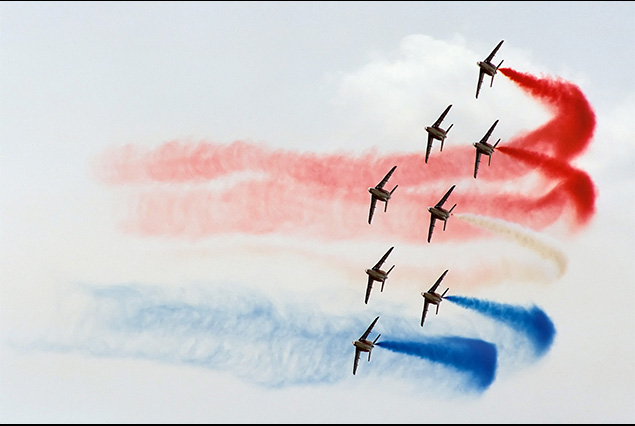
And here's the delicious irony: the original B-2 design actually included a tank for a chemical additive to be mixed into the exhaust — to suppress the contrail. It was dropped in favour of the lidar. Apart from the deliberately showy airshow smoke systems, the documented military exhaust-additive work on contrails has aimed at one thing only: eliminating visible trails, not creating them.
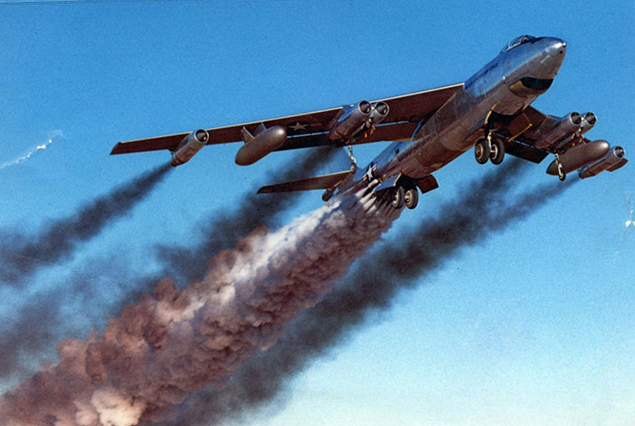

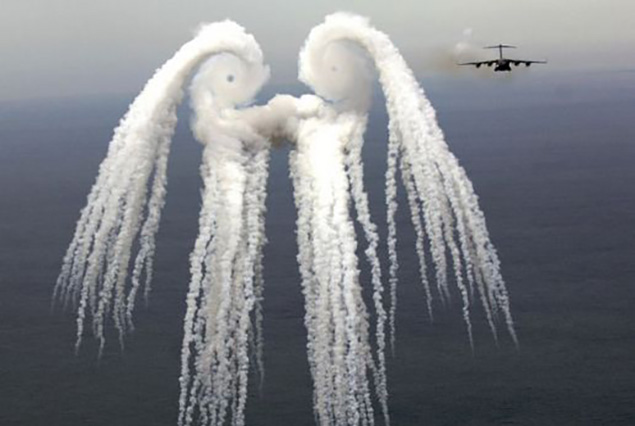
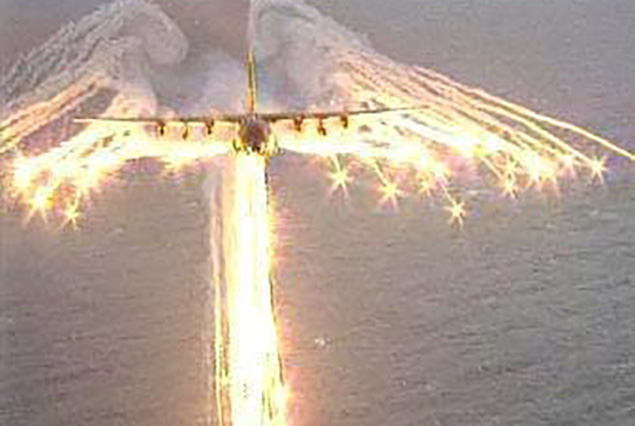
Think it through: thousands of civilian aircraft supposedly spray highly visible trails in secret, while the military — which actually knows how to make and predict trails — treats a visible trail as mission failure. Both cannot be true.
Contrails in all their varieties
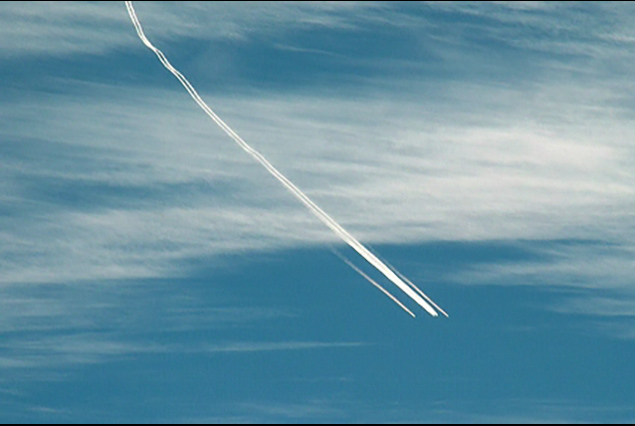
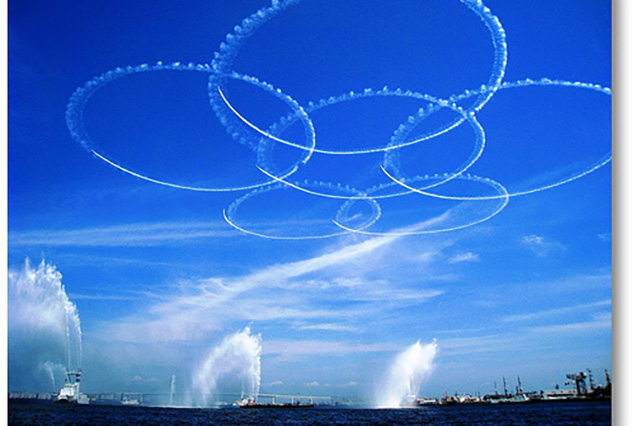
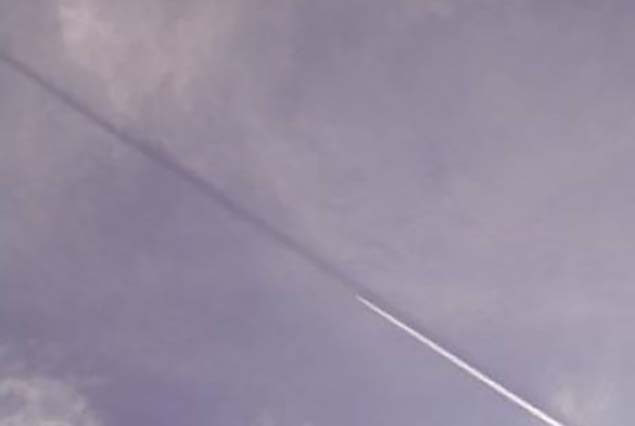
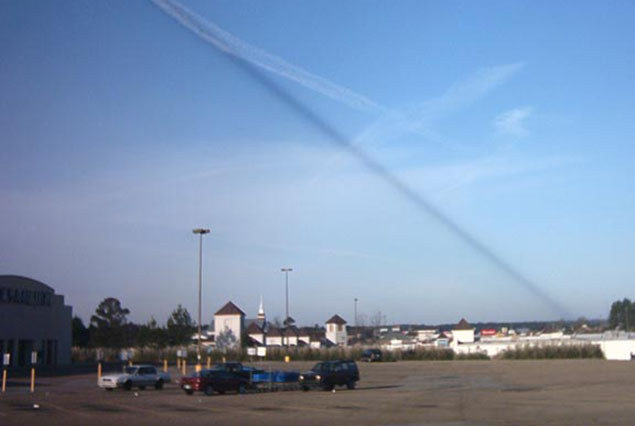
Contrails are not always white, straight or equal. The sun's angle can light them red from below; wind — which varies with altitude and even blows vertically in clear-air turbulence — bends and shears them; a turning aircraft draws circles at an airshow; a big bomber burning far more fuel than its escorts draws a far thicker line. And when the sun aligns just right, a trail casts its own shadow onto haze below, producing the mysterious "black beam" photos.

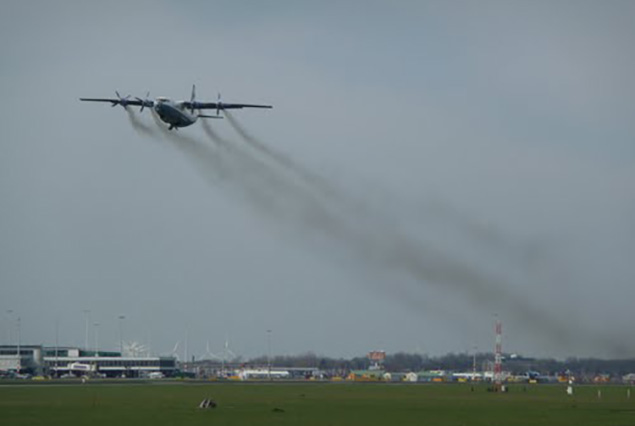
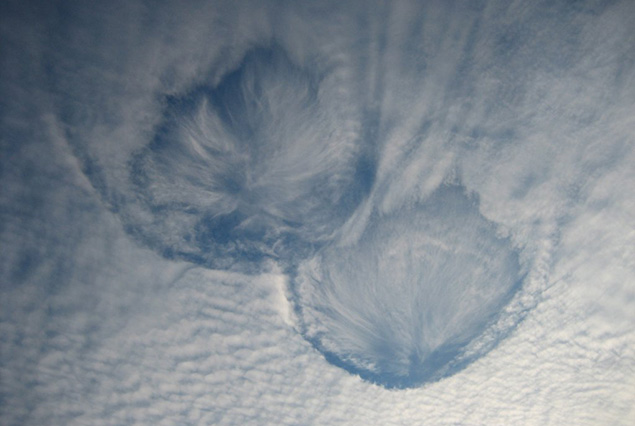
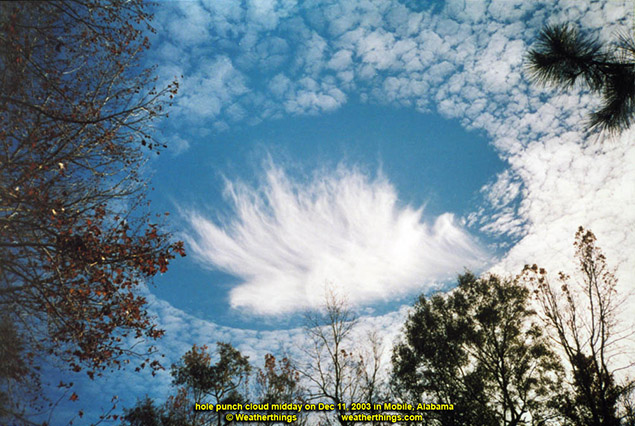
Distrails & hole-punch clouds — aircraft erasing clouds
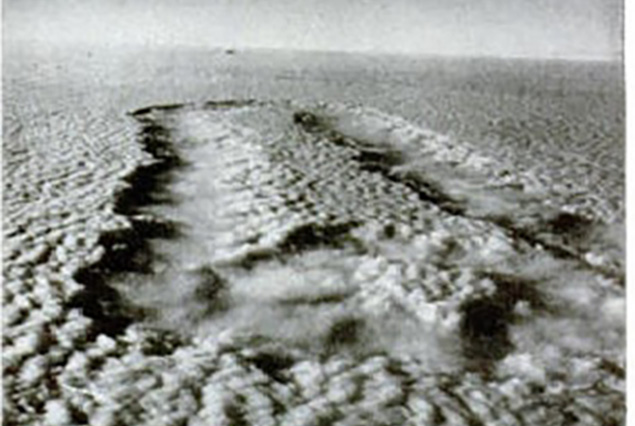
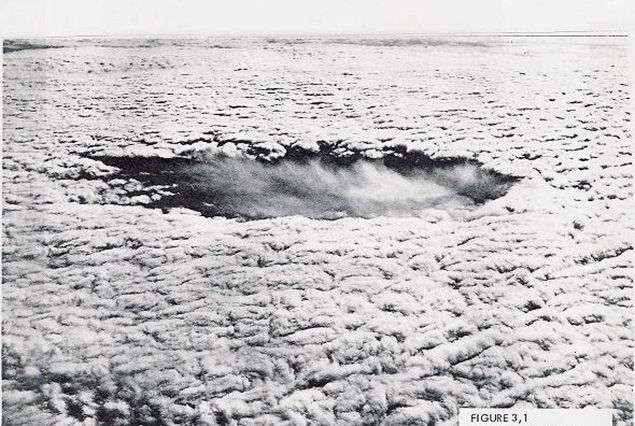
Aircraft can also do the opposite of leaving a trail: they can delete cloud. Mid-level cloud layers often consist of water droplets supercooled to about −15 °C — still liquid, because without a freezing nucleus droplets only freeze spontaneously below about −40 °C. Air expanding over a passing aircraft's wings and propeller tips cools locally by 20 degrees or more and flash-freezes them. The new ice crystals grow at the droplets' expense and fall out as feathery streaks, leaving a hole (crossing steeply) or a long canal (flying along the layer). NCAR researchers documented the process in Bulletin of the American Meteorological Society — near Denver airport it has even produced measurable snowfall. Inadvertent, well-published, pure ice physics.


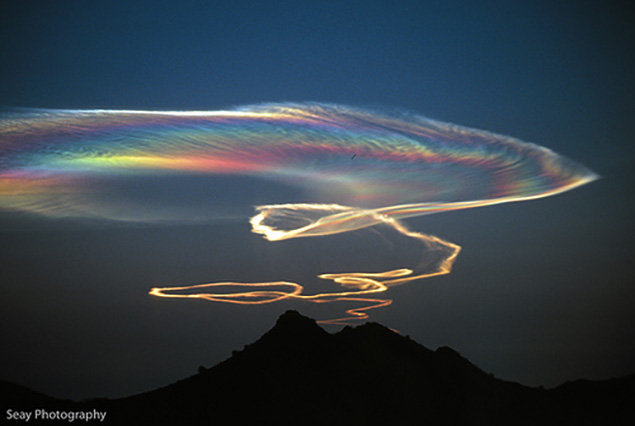
Rockets & exotic engines
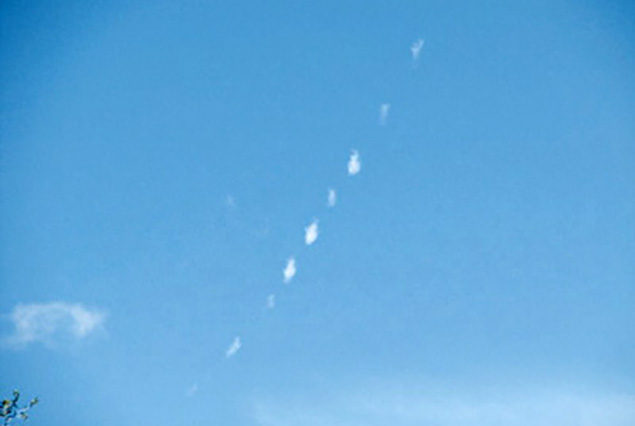
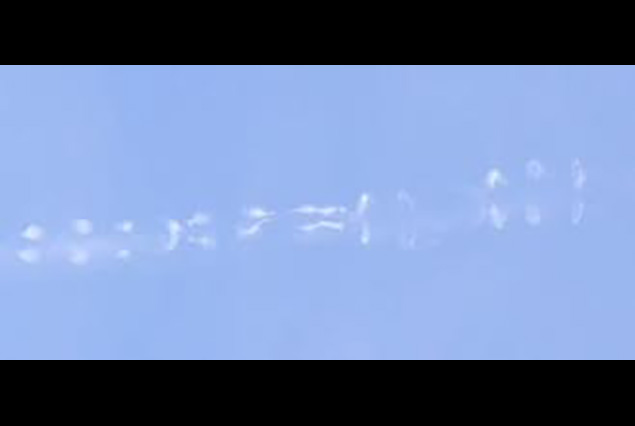
Rocket trails twist as they climb through wind layers blowing in different directions; at dawn or dusk they catch sunlight while the ground sits in darkness, producing spectacular colours. Experimental engines write their own signatures: the Mach-6.7 X-15 rocket plane; ramjets (supersonic engines with no moving compressor — they only work at speed); scramjets (their hypersonic cousins, Mach 5+); and experimental pulse-detonation engines, credited with the distinctive dashed "donuts-on-a-rope" trails from discrete detonations.


Wake turbulence — tornadoes from the wingtips
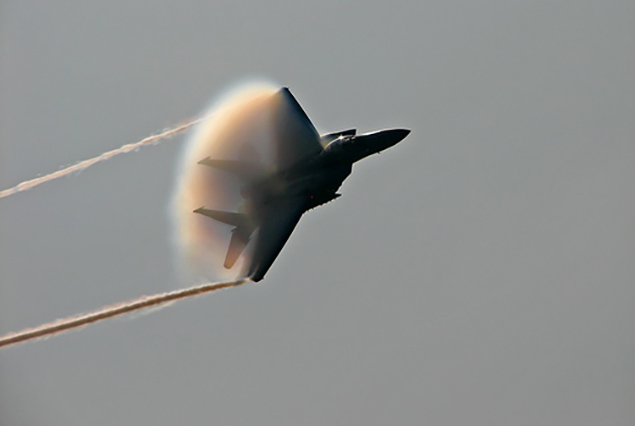
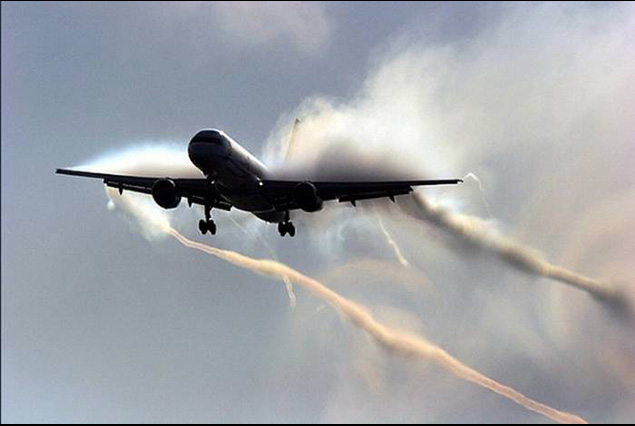
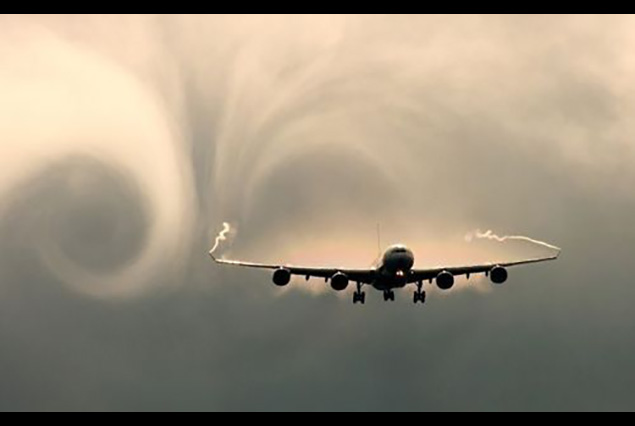
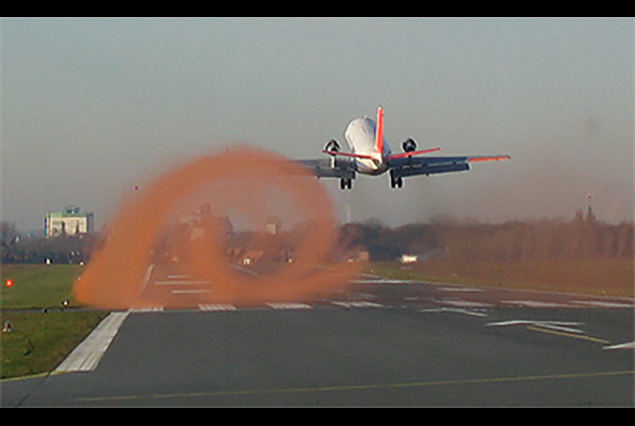
Every wing generating lift spills high-pressure air from below around its tips into powerful rotating vortices. The heavier the aircraft, the stronger the vortex — strong enough to roll a smaller aircraft following too closely, which is why air traffic control enforces wake-separation distances and pilots are trained to stay above a preceding heavy's flight path.

Inside the vortex core the pressure drops so low that moisture condenses, making the vortex visible as a rope of cloud — a small horizontal tornado. This is often photographed as a "chemtrail," but it forms by a completely different mechanism than a contrail, typically at low altitude in humid air, and it's gone in moments. Test aircraft sometimes fly with smoke generators precisely to make these vortices visible for research.





.jpg)
Fuel dumping — the emergency exception
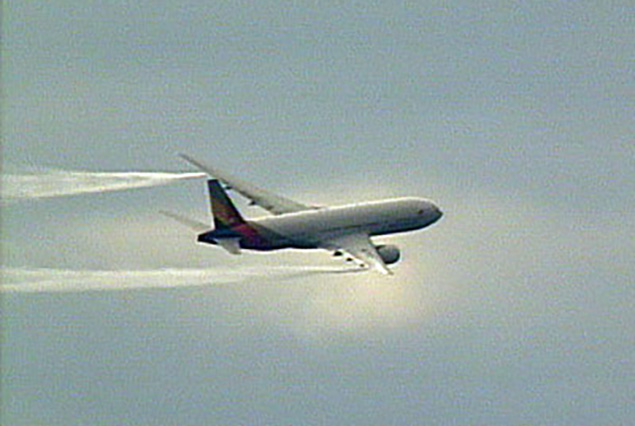
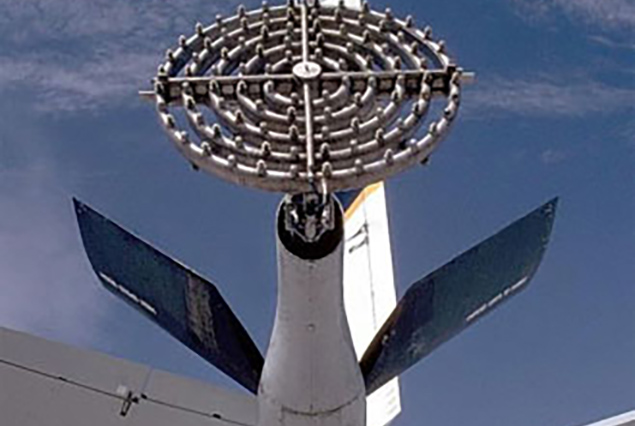
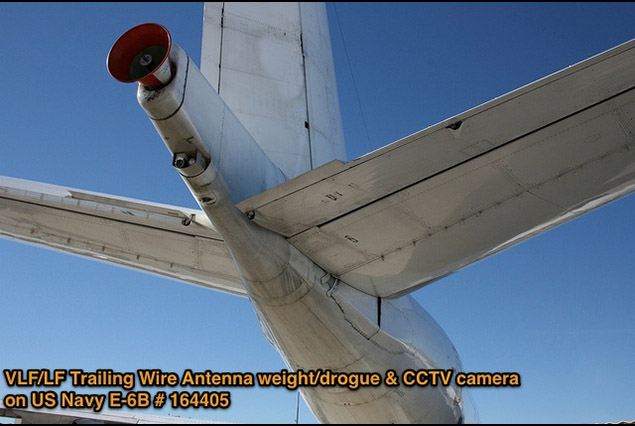
If an aircraft must land soon after takeoff — say an engine problem on a fully fuelled long-haul flight — it may be too heavy to land safely. In that rare emergency, fuel can be jettisoned through dedicated nozzles near the wingtips or tail, at an altitude and speed chosen so the kerosene disperses and evaporates before reaching the ground, coordinated with air traffic control away from populated areas. It looks dramatic, it photographs like "spraying" — and it is a documented, regulated, rare emergency procedure.
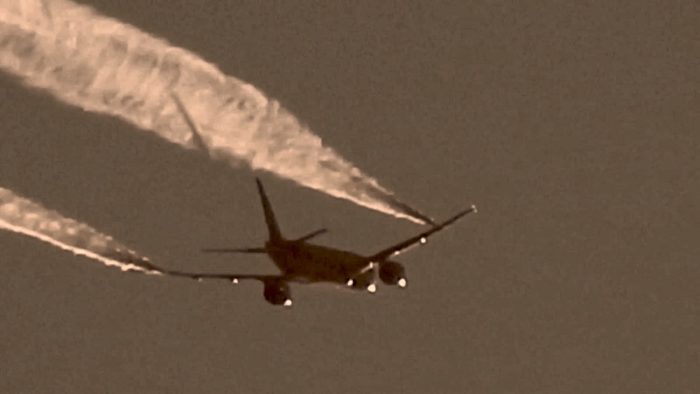
Occasionally fuel also vents unintentionally when a tank overflows during transfer — expelled through a controlled outlet to prevent overpressure. And since we're talking about what's in the tanks: jet fuel is a placarded, quality-controlled product. Before uplift it gets sampled and checked for water and contamination — in my Hawker 800 days at London City I regularly stood next to the bowser watching exactly that happen.




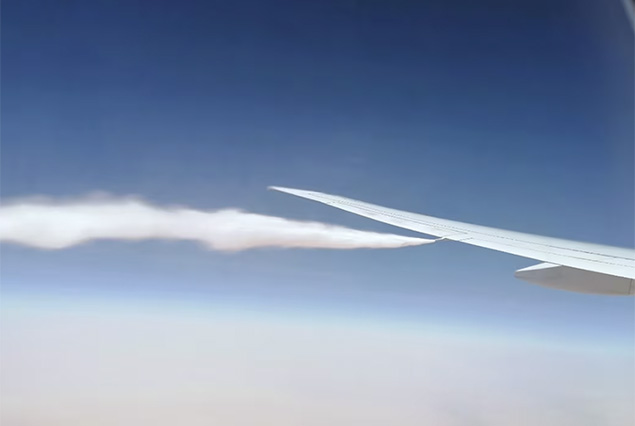


Aerial refuelling
Military aircraft refuel in flight from tanker aircraft to complete long missions — a boom or hose links the two aircraft nose-to-tail. Photos of the process, and of the occasional fuel spray when a connection breaks, circulate regularly as "spraying evidence." It's a tanker, doing tanker things, at public airshows and in press photos.
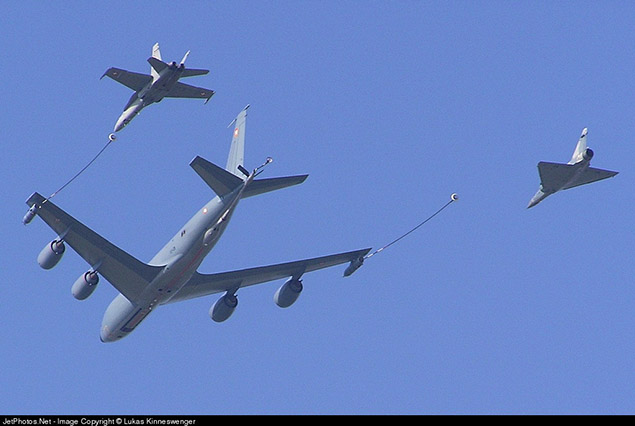

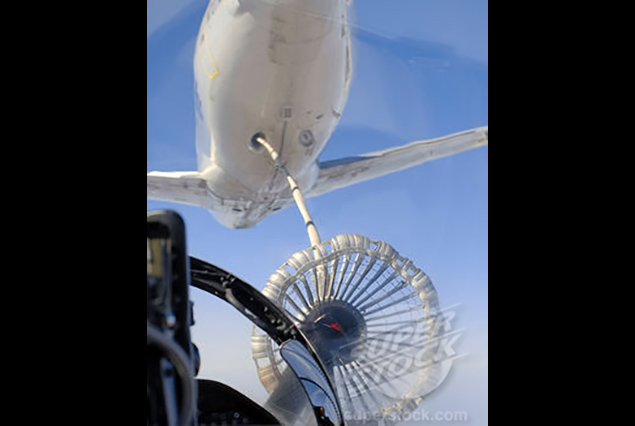
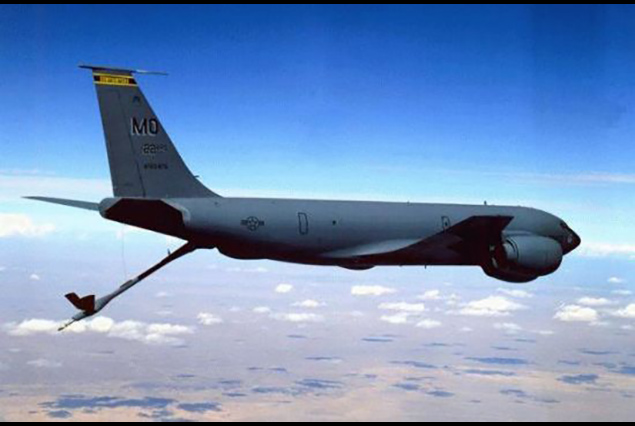
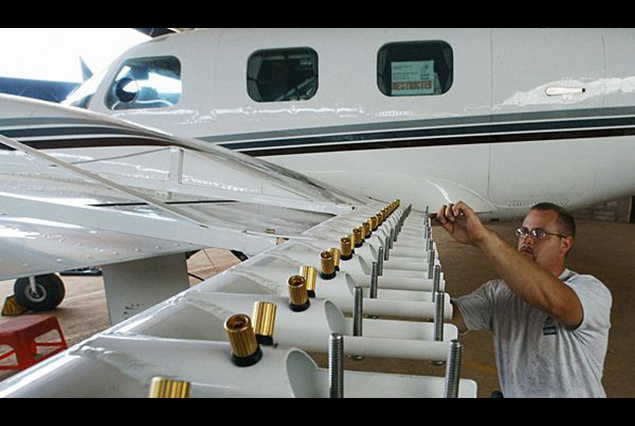
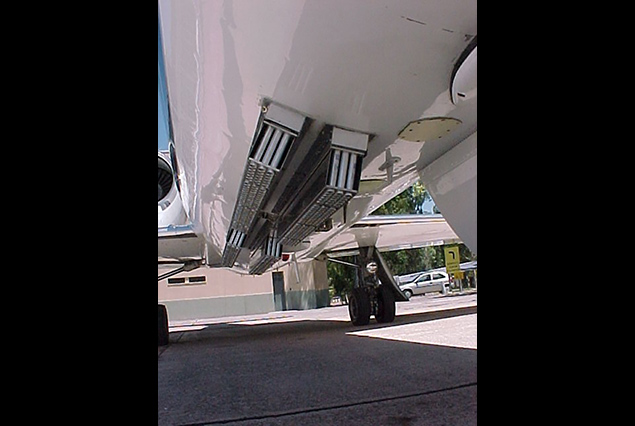
Yes, weather modification exists — and it's nothing like the chemtrail story. Cloud seeding disperses particles into existing clouds to nudge precipitation: silver iodide (whose crystal structure mimics ice), dry ice, or hygroscopic salts. It's used to boost rain or snowfall in dry regions, suppress hail, and clear fog from airports.
Seeding needs clouds containing supercooled liquid water — droplets colder than 0 °C that haven't frozen for lack of an ice nucleus. Silver iodide provides the nucleus; dry ice chills the air until crystals form spontaneously. Once ice appears among supercooled droplets, it grows at their expense (vapour pressure over ice is lower than over water) until heavy enough to fall. In convective clouds, "dynamic" seeding also exploits the latent heat released by freezing to strengthen updrafts.

Crucially for our topic: cloud seeding is low-altitude, small-scale, and public. The UAE announces its ~300 seeding missions a year; US state programmes file reports with NOAA; China publishes its programmes. Operators use kilograms of material in individual clouds — not megatons across the globe at cruise altitude. The 1946 photo below shows how visible and documented this has been from the very start.




"But Bill Gates is funding weather manipulation!" — let's look at that
Whenever cloud seeding comes up, someone posts an article "proving" that Bill Gates is building chemtrail technology. The articles are real; the conclusion doesn't follow. Here is what Gates has actually funded, all of it announced publicly at the time:
Open academic research. For years Gates personally funded a small university research fund run by climate scientists Ken Caldeira and David Keith — a few million dollars for openly published climate and energy studies, a slice of which examined solar geoengineering on paper and in computer models. Around 2010, roughly $300,000 of it went to feasibility studies of "marine cloud brightening" — the idea of spraying seawater mist to brighten low ocean clouds. Salt water, computer models, published papers.
The famous balloon. The project every viral post points to, Harvard's SCoPEx experiment, planned to release about 2 kg of calcium carbonate — roughly one bag of flour — from a research balloon at 20 km, purely to measure how such particles behave. After years of public governance review and protest (notably from the Saami Council in Sweden), it was cancelled in March 2024 without ever releasing a single gram.
Now hold that against the chemtrail story. One of the richest, most-watched men on Earth spent years failing to get permission to release one bag of flour into the stratosphere — with public websites, advisory committees and press coverage every step of the way. The theory meanwhile claims thousands of anonymous airliners spray megatons daily with no paper trail. Research is not deployment: scientists study solar geoengineering precisely so bodies like the IPCC can judge whether it could ever be safe, and that research is argued about entirely in public — the opposite of a secret.
And one technical detail unravels the whole connection: stratospheric aerosol ideas need altitudes of about 20 km — nearly twice as high as the 10–12 km where airliners fly and contrails form. As the Harvard engineering study cited further down concluded, no existing aircraft can even reach that regime with a useful payload. The trails you photograph above your house are physically incapable of being the technology in those articles.
Icing tests
To certify anti-ice systems, tanker aircraft fitted with spray rigs fly ahead of a test aircraft and spray water onto it in freezing conditions, building ice on wings and engine inlets under controlled, instrumented conditions. Photos of these spray booms are a staple of chemtrail websites — they are water sprayers, for ice, used over test ranges.
Water-ballast barrels: the most famous "evidence" of all
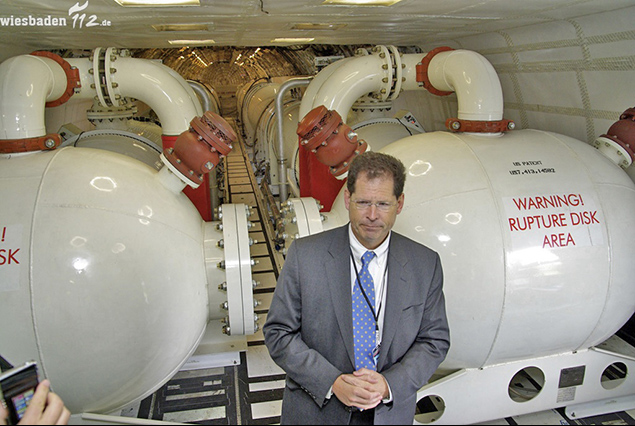
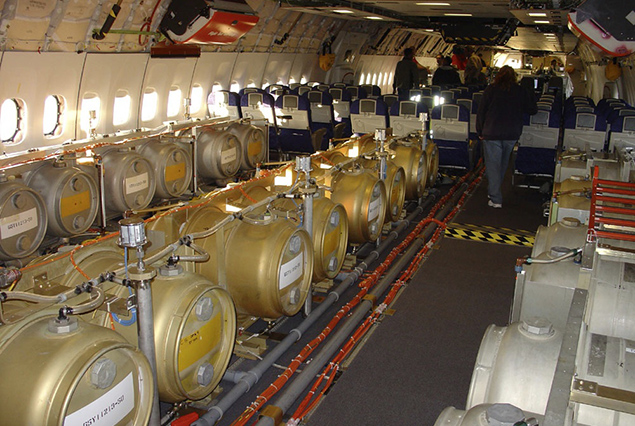
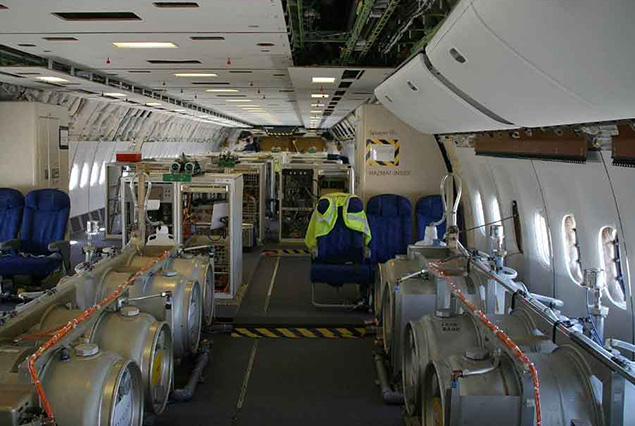
Cabin photos of airliners filled with barrels and tubing show certification test aircraft. You can't put 400 passengers on an uncertified aircraft, so barrels of water stand in for them; pumping water between barrels shifts the centre of gravity in flight, exactly as passengers moving about would. One widely shared version of the Boeing 747-8 test cabin even had a biohazard sign photoshopped in. Boeing and Airbus publish these photos openly — they're proud of them.

Weight & balance — why those barrels matter
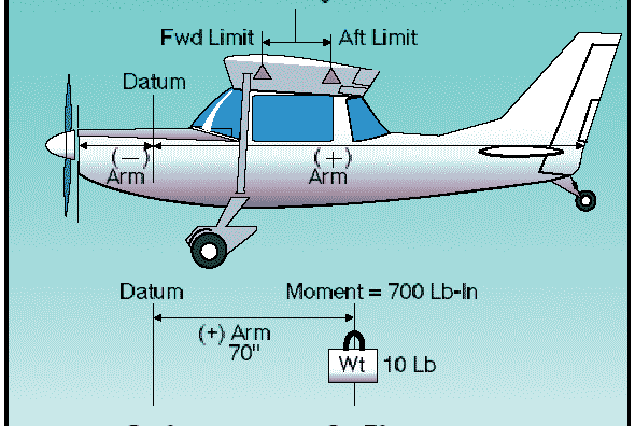
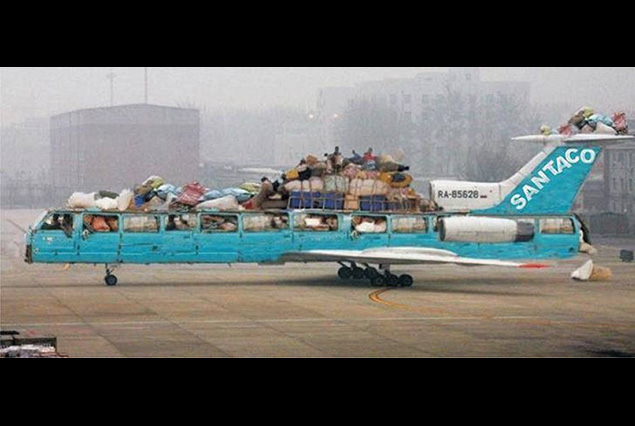
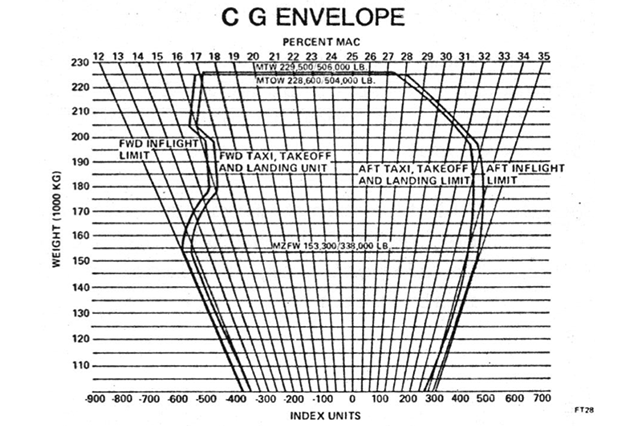
You can't just load an aircraft with baggage and passengers anywhere you like. If too much weight sits aft, the aircraft pitches up more than the controls can comfortably counter; too far forward, the same problem in reverse. Every aircraft has a certified centre-of-gravity envelope — a graph of weight against balance point — and every single flight is planned inside it. Establishing that envelope is exactly what the water-ballast test flights are for: water is heavy, precisely measurable, and pumpable in flight.




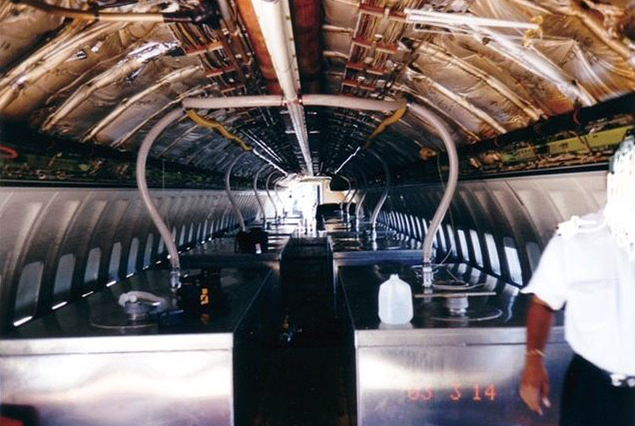
The strange tale of N844AA
One barrel photo in the set above really is different: it shows cabin tanks for fuel. That's the Boeing 727 N844AA, converted to deliver diesel to Angolan diamond mines. On 25 May 2003 it took off from Luanda without clearance, transponder off — and was never seen again, one of aviation's genuine unsolved mysteries. Even our best mystery plane involves ordinary diesel and an insurance nightmare, not chemtrails.

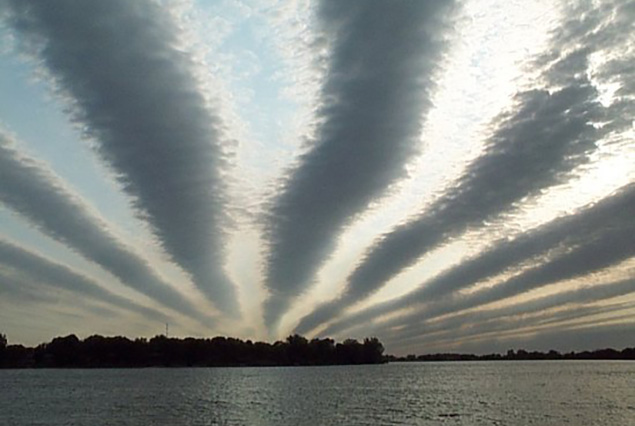
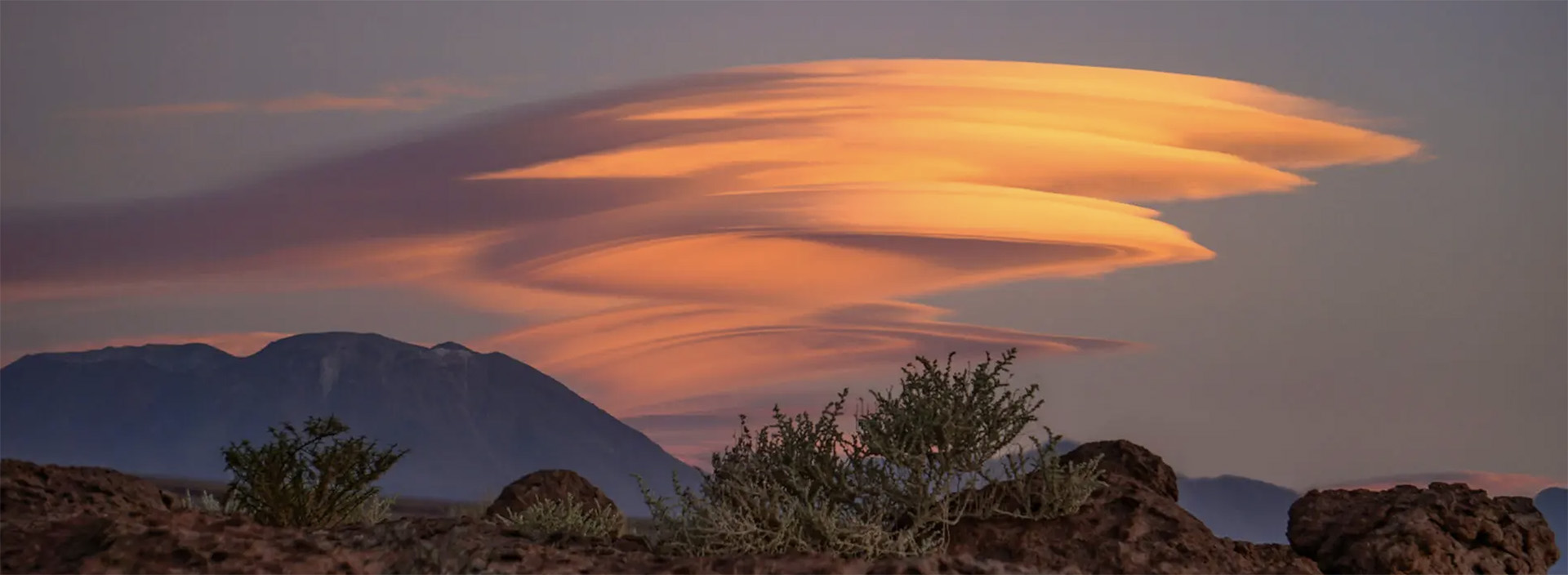
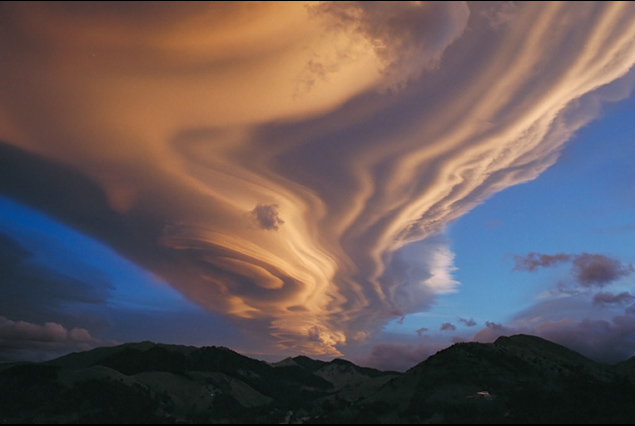
Nature produces plenty of clouds that look artificial. Lenticular clouds — the smooth "UFO lenses" — form in standing waves downwind of mountains, where air is forced up and down like water over a rock. They hang motionless while wind howls through them, which is exactly why they attract theories. Nacreous (mother-of-pearl) clouds glow in the stratosphere at 20 km; electric-blue noctilucent clouds shine from the edge of space at ~80 km, lit by the sun long after dark. And Saharan dust rides the wind for thousands of kilometres — that reddish film on your car after rain — showing up on weather radar as dramatic blooms that get screenshotted as "spraying operations."
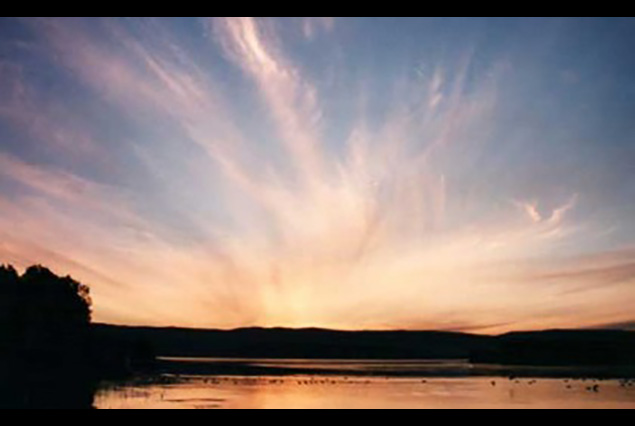


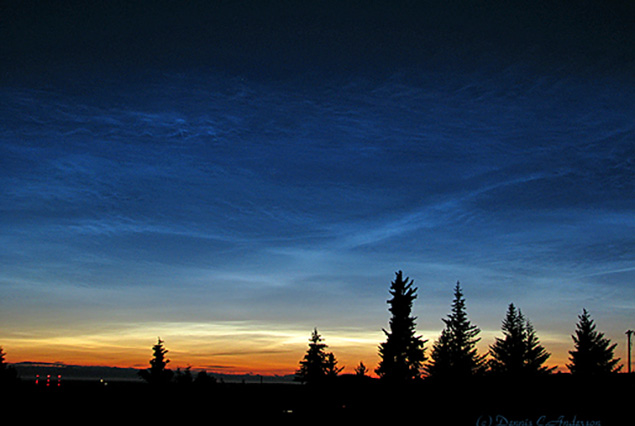


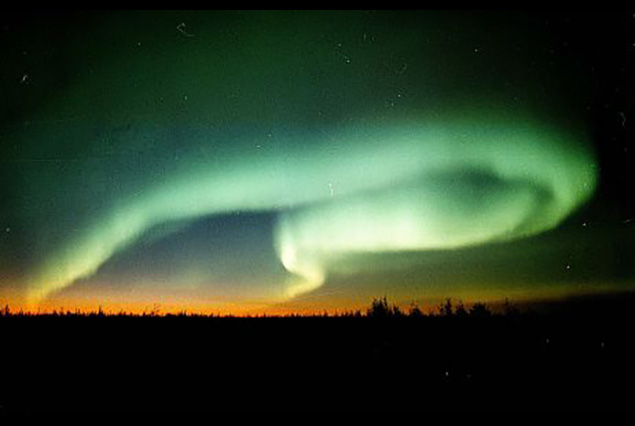
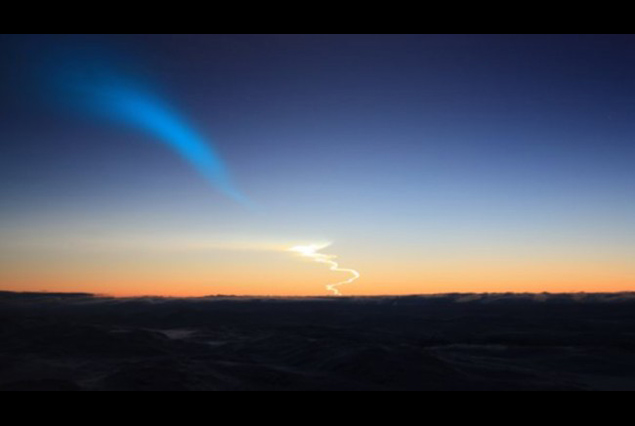
The aurora is the atmosphere glowing at 80–1,000 km altitude, where charged particles from solar eruptions — steered by Earth's magnetic field toward the poles — slam energy into oxygen and nitrogen atoms. Curtains, arcs, beams, and on rare nights whole skies of flame; its physics was pinned down during the International Geophysical Year of 1957–58. Comets are "dirty snowballs" of ice, gas and dust whose tails can stretch over 150 million kilometres when the sun warms them. Meteors flash and leave glowing trains. And rocket launches at twilight paint twisted, iridescent plumes that generate a fresh wave of panicked sky photos every single time.







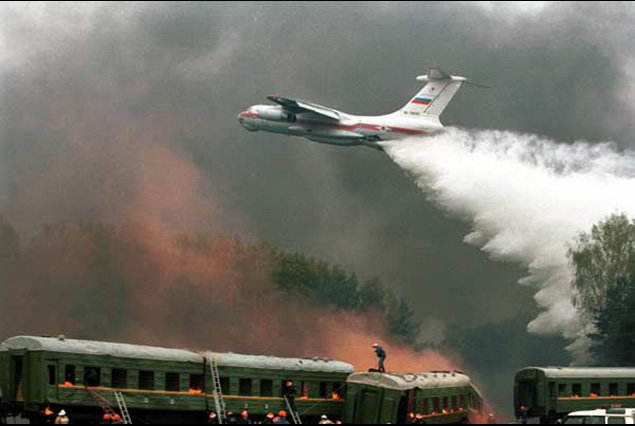
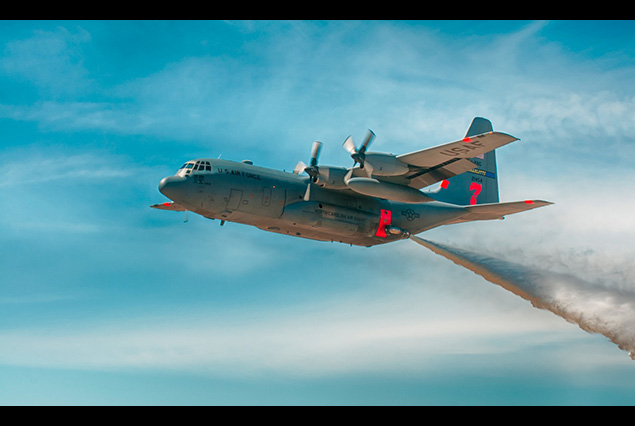
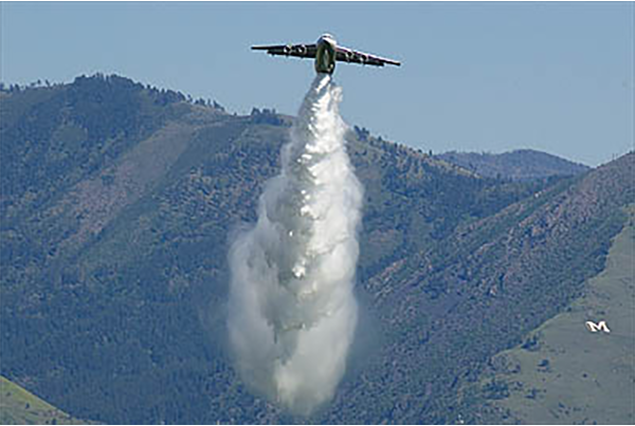
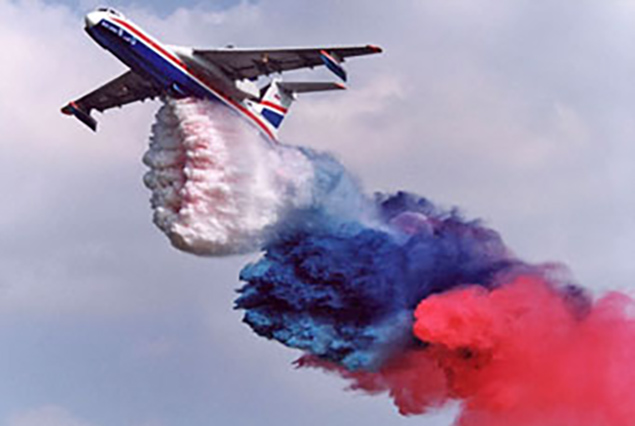
When you need to hit a wildfire fast, nothing beats an aircraft. Purpose-built tankers drop water or red retardant slurry in massive, low-altitude passes — including converted airliners like the Boeing 747 Supertanker pioneered by Evergreen International Aviation of McMinnville, Oregon. The belly plumbing and nozzle arrays of these aircraft are shown off openly at demonstrations — and, inevitably, photos of them circulate online labelled as chemtrail hardware.






Part 5 — The greatest hits
Debunking the classics
The theory took off in the late 1990s: a September 1997 mailing-list post, a January 1999 article, and two appearances on Art Bell's midnight radio show lit the fuse. Believers pointed at a real 1996 Air Force student paper — "Weather as a Force Multiplier: Owning the Weather in 2025" — which was an openly speculative academic exercise carrying a disclaimer that it described fictional future scenarios. By 2000 the EPA, FAA, NASA and NOAA had issued a joint fact sheet, and the Air Force had published its own rebuttal calling the whole thing a hoax. The "evidence" that has circulated since falls into a few recognisable classics:
🎚️ The "chemtrail switch"

Cockpit photos of "CHEMTRAIL" switches are pranks — joke stickers on real panels (like this one) or photoshopped labels. The most famous one, exposed by Snopes, is an Embraer panel whose real switch says STERILE (the sterile-cockpit light) — the hoax font doesn't even match. Pilot humour, I'm afraid — the joke is on the hoax, and the mismatched fake font gets us every time.
🛢️ The barrel planes
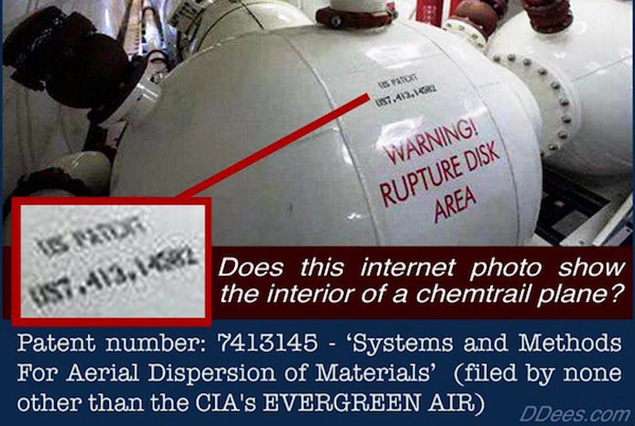
The meme above recycles a flight-test water-ballast photo (you saw the real rigs in the Weight & Balance section). One viral version added a biohazard sign digitally. Certification aircraft carry water barrels because passengers can't legally fly on an uncertified aircraft — that's it.
🧪 The rainwater "lab tests"
The famous 2007 Louisiana TV report of "dangerous barium" rested on a 100× unit error: the lab measured 68.8 micrograms/L; the report read it as 6.8 ppm. The real value was about 3.4% of the EPA drinking-water limit. Aluminium is ~8% of the Earth's crust — any sample touched by dust "tests positive." Full walk-through of a real lab report here.
🔬 The expert survey
In 2016, researchers from Carnegie/Stanford and UC Irvine published a peer-reviewed survey of the world's leading atmospheric chemists and geochemists: 76 of 77 had encountered no evidence of any secret spraying programme, and the standard "evidence" was fully explained by ordinary contrail physics (Shearer et al., Environ. Res. Lett.). The one dissenter reported only an unexplained barium reading — with no link to aircraft.
➗ The secrecy math
A 2018 Harvard engineering study of hypothetical stratospheric aerosol programmes concluded no existing aircraft can even do the job, and a minimal purpose-built fleet would involve "far too much flight activity to remain undetected." A 2016 PLOS ONE model of real leaked conspiracies found schemes with thousands of participants unravel within a few years. A global programme needing complicity from airlines, refuellers, mechanics, regulators and hundreds of thousands of pilots? It would leak before lunch.
📜 The "government admissions"
The 2001 Kucinich bill listing "chemtrails" was written by outside activists, died in committee, and lost the word in every later version. Tennessee's 2024 law "banning chemtrails" bans an activity nobody could show was happening. And solar-geoengineering research (like Harvard's SCoPEx, cancelled in 2024 without releasing a gram) is conducted entirely in public — which is the opposite of a secret programme.
One more honest note: surveys show roughly one in ten people find the theory "completely true," across all political stripes. If that's you — you're not stupid, and you are noticing something real. The sky genuinely does carry more lingering trails than it did in 1980. The explanation just turns out to be traffic, thermodynamics and better engines — all measured, published and predicted by a formula older than the jet engine itself.
Agent Orange & Agent Blue: the darkest chapter
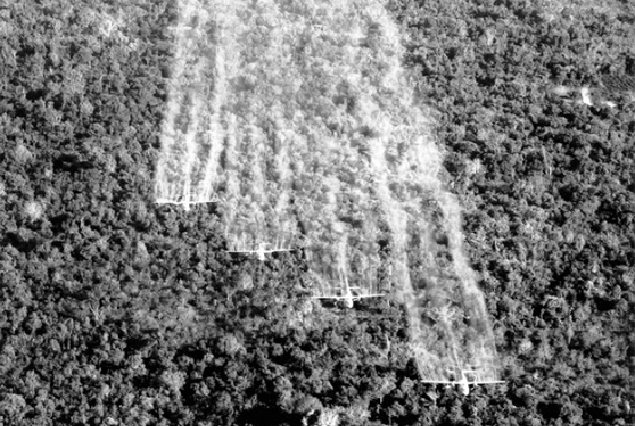
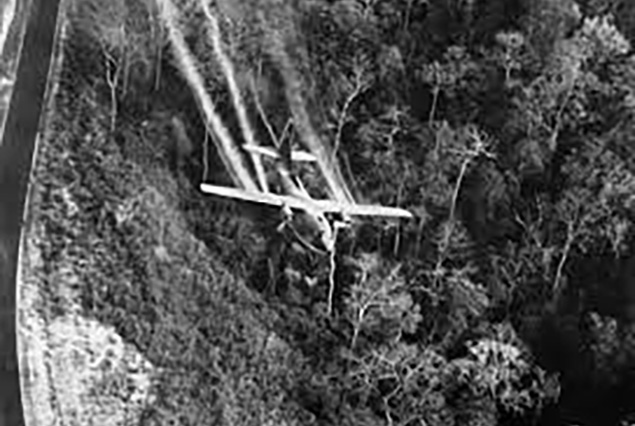
During the Vietnam War the United States sprayed over 19 million gallons of herbicides in Operation Ranch Hand (1962–1971). Agent Orange, contaminated with dioxin — one of the most toxic substances ever made — stripped the jungle; Agent Blue desiccated rice crops. The consequences were horrific: devastated forests, generations of birth defects and cancers among Vietnamese civilians, and severe illness among US veterans.
Notice what real chemical spraying looked like: low-flying transport aircraft, dense visible plumes settling onto the land, tonnes of documented chemicals, official records — and, eventually, public exposure, lawsuits and compensation programmes. Real spraying cannot stay hidden. That is precisely the point.




Crop dusting & mosquito control
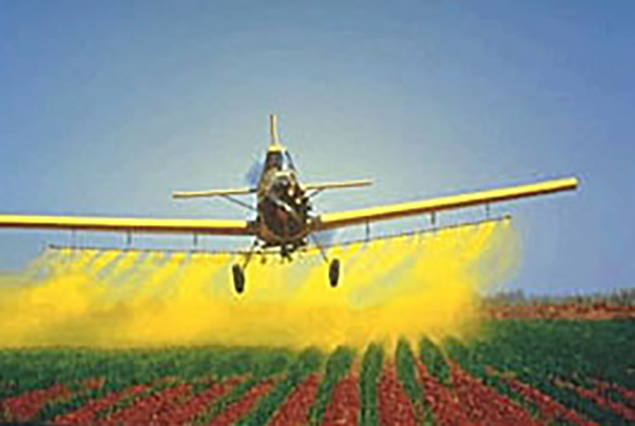
Agricultural aircraft spray pesticides and fertilisers from a few metres above the field; public-health aircraft have sprayed for mosquitoes since the DC-4 era. Low, loud, obvious — and licensed.




Military chaff — the radar cloud
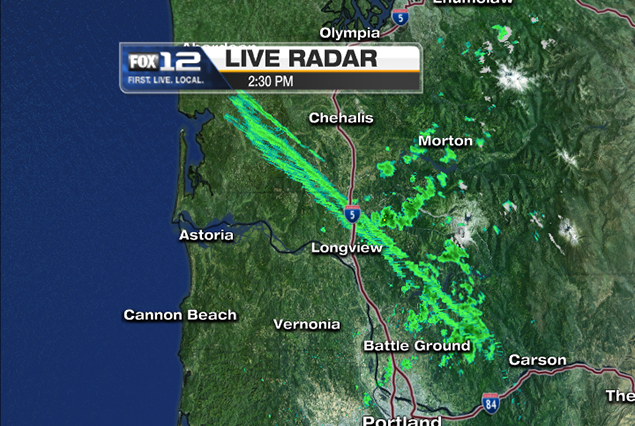
Militaries also disperse chaff: clouds of radar-reflecting strips that blind or decoy radar — today aluminium-coated glass fibres; in WWII, strips of aluminium foil the British code-named "Window" when they dropped them over Hamburg in 1943. Chaff shows up as strange blooms on weather radar and occasionally triggers "spraying operation" panics — but it's a public, documented countermeasure with its own training ranges and NOTAMs.
Part 7 — The honest ending
The real contrail story is being handled in the open
Here's the part that deserves your attention far more than any conspiracy: contrails do affect the atmosphere — as clouds. Persistent trails spread into contrail cirrus covering roughly nine times the area of the visible lines, thin ice veils that let sunlight in but trap heat radiating out. The leading scientific assessment (Lee et al. 2021) estimates this warming effect currently exceeds the warming from all the CO₂ aviation has ever emitted — the largest single piece of aviation's climate footprint, albeit with wide error bars.
And the response is happening in full public view. Because only about 2% of flights cause roughly 80% of the contrail warming (the ones crossing big humid regions toward evening), small reroutes fix most of the problem: in 2023, Google, Breakthrough Energy and American Airlines showed AI-guided altitude tweaks cut contrail formation by 54% across 70 test flights; EUROCONTROL's Maastricht control centre ran live trials steering 209 flights around ice-supersaturated layers. Airlines, air traffic control and scientists are openly working to make fewer trails — the exact opposite of a programme to spray more.
That's the pattern everywhere you look in this story: the real science is public, argued about, peer-reviewed and improving. Fear needs shadows; this subject doesn't have any.
Quick answers
Frequently asked questions
Are chemtrails real?
What's the difference between a chemtrail and a contrail?
Why does one plane leave a trail while another right next to it leaves none?
Why do some trails vanish in seconds and others spread all day?
Are contrails harmful to breathe?
Why are there so many more trails than when I was young?
What about the photos of cabins full of barrels?
Isn't Bill Gates funding chemtrails?
Isn't cloud seeding proof they're spraying us?
Why do trails form grids and crosses?
Could a programme this big actually stay secret?
What readers say
From the mailbox
"Finally someone who shows the facts."— John Deer
"Thank you for all the detailed explanation on how it really works."— July Mathews
"Even though there seem to be a lot more of them in the sky and surely not healthy, at least no big conspiracy behind it."— Evert Tuinman
Get in touch
Questions? Spotted something odd in the sky?
Send me a photo or a question — curious skeptics are exactly who this site is for. I read everything, and if you've caught a genuinely interesting phenomenon I might add it to the field guide (with credit).
Johannes van Ouwerkerk
Maarssen, The Netherlands
+31 6 2007 6446
info (at) eraofenlightenment.com